Guidelines for supplementing fats in dairy cows using lysolecithin from GN Good Nutrition

Guidelines for Supplementing Fats in Dairy Cows (Part 2)

Supplementing fats needs careful consideration due to their high cost and potential negative impacts:

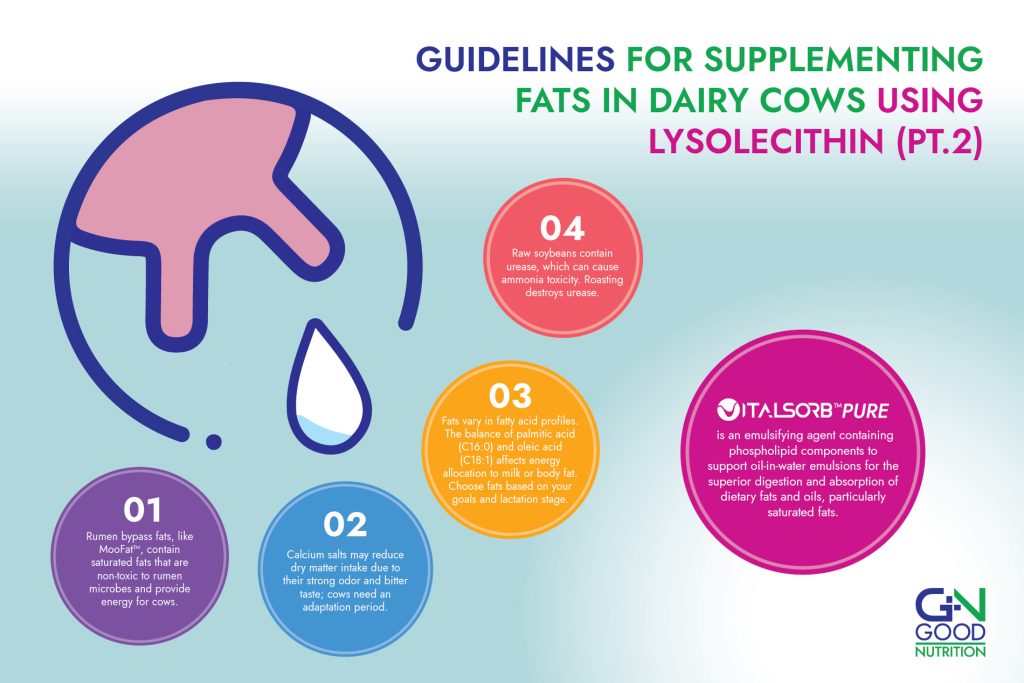
1. Because rumen bypass fats contain saturated fats (for example, MooFat™ range of bypass fats), they are not toxic to the rumen microbes and pass through the rumen unaltered, providing an energy source for the cow.

2. Calcium salts may depress dry matter intake, possibly due to their pungent odor and slightly bitter taste. Cows that have not had previous exposure to these fats may require an adaptation period.

3. Not all fats are the same, as their fatty acid profiles differ. They should be selected based on individual fatty acids supplied by a fat source, specifically the balance of the saturated fat, palmitic acid (C16:0) and the unsaturated fat oleic acid (C18:1). Increased palmitic acid leads to increased partitioning of energy to milk, primarily through increased milk fat production (milk has a relative high concentration of C16:0), whereas stearic acid directs energy toward body fat reserves. The best by-pass fat for dairy cows is therefore dependent upon your aim and stage of lactation.

4. Raw soybeans are a good source of fat, however, they contain urease, an enzyme that breaks down urea to ammonia in the rumen, which could cause ammonia toxicity. Roasting soybeans is recommended to destroy the urease.

Vitalsorb™ Pure is an emulsifying agent containing phospholipid components to support oil-in-water emulsions for the superior digestion and absorption of dietary fats and oils, particularly saturated fats.

Guidelines for supplementing fats in dairy cows using lysolecithin from GN Good Nutrition

Guidelines for Supplementing Fats in Dairy Cows (Part 1)

Supplementing fats needs careful consideration due to their high cost and potential negative impacts:

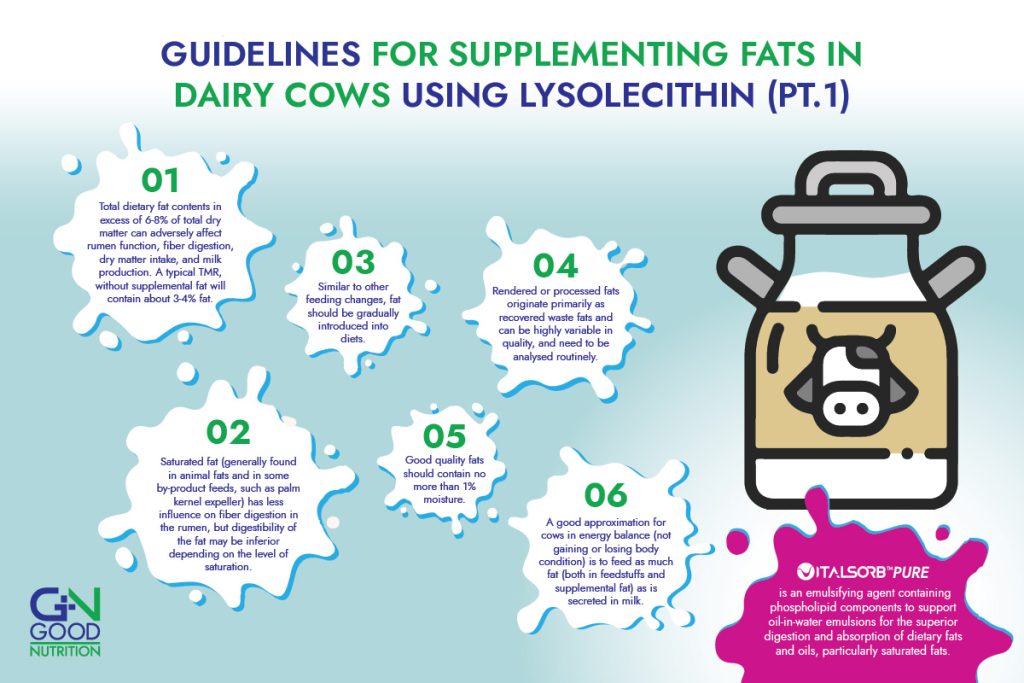
1. Total dietary fat contents in excess of 6-8% of total dry matter can adversely affect rumen function, fiber digestion, dry matter intake, and milk production. A typical TMR, without supplemental fat will contain about 3-4% fat.

2. Saturated fat (generally found in animal fats and in some by-product feeds, such as palm kernel expeller) has less influence on fiber digestion in the rumen, but digestibility of the fat may be inferior depending on the level of saturation.

3. Similar to other feeding changes, fat should be gradually introduced into diets.

4. Rendered or processed fats originate primarily as recovered waste fats and can be highly variable in quality, and need to be analysed routinely.

5. Good quality fats should contain no more than 1% moisture. 6. A good approximation for cows in energy balance (not gaining or losing body condition) is to feed as much fat (both in feedstuffs and supplemental fat) as is secreted in milk.

Vitalsorb™ Pure is an emulsifying agent containing phospholipid components to support oil-in-water emulsions for the superior digestion and absorption of dietary fats and oils, particularly saturated fats.

improving fat digestion in dairy cows with vitalsorb lysolecithin

Improving Fat Digestion and Performance In Dairy Cows

Although the major reason for feeding fat is for its energy density, other benefits are well recognised:

Energy is the most critical nutrient affecting milk production of lactating dairy cows. Fats are commonly supplemented to dairy cow rations to increase dietary energy density (fats contain approximately 2.25 times more energy than cereals, and don’t add to the acid load in the rumen), to improve milk production and milk fat content, and energy balance to benefit body condition and hence fertility. Replacing carbohydrate sources of energy with fat also reduces the production of methane, a potent greenhouse gas.

Furthermore, the heat increment associated with digestion and metabolism of fat is much lower than other feed ingredients, helping to combat heat stress. Fats aid in the absorption of fat-soluble nutrients, such as vitamins A, D, E and K, and carotenoids.

However, with the recent high prices of fats, strategies to improve cost-effectiveness needs to be considered, particularly as prices are expected to remain historically high.

Vitalsorb™ Pure is an emulsifying agent containing phospholipid components to support oil-in-water emulsions for the superior digestion and absorption of dietary fats and oils, particularly saturated fats.

Guidelines for rearing calves with milk replacers using lysolecithin from GN Good Nutrition.

Guidelines For Rearing Calves With Milk Replacers Part 4

Calf feeding and management practices have been shown to significantly impact lifetime performance, therefore they should be considered as an investment, not as a cost.

1. A new-born calf will spend over 80% of their time lying down, therefore it is important to always provide a deep, warm, dry bedding.

2. At the first sign of scours, begin electrolyte therapy.

3. Antibiotics may be indicated with scours, but many forms of scours are caused by microbes such as viruses which are not controlled by antibiotics. Consult your veterinarian for guidance on the use of antibiotics in scouring calves.

4. Wean no earlier than six weeks of age, in a step-down approach.

Vitalsorb™ Pure is an emulsifying agent containing phospholipid components to support oil-in-water emulsions for the superior digestion and absorption of dietary fats and oils, particularly saturated fats.

Guidelines for rearing calves with milk replacers using lysolecithin from GN Good Nutrition.

Guidelines For Rearing Calves With Milk Replacers Part 3

Continuing our series of farmer-adopted guidelines, we’re emphasising the importance of these practices which have proven to have a significant impact on lifetime performance. With our Vitalsorb Pure lysolecithin, read on to know more how it plays a part in the process.

1. A rule of thumb is to increase the amount of CMR by 2% for every degree below 10°C.

2. If you change CMR during feeding, do it gradually over 4-5 days to prevent nutritional scours and digestive upset.

3. Solid feeds (forages and concentrates) should be introduced from one week of age and be freely available before weaning.

4. Gradual transitions between feed types should occur over two weeks.

Vitalsorb™ Pure is an emulsifying agent containing phospholipid components to support oil-in-water emulsions for the superior digestion and absorption of dietary fats and oils, particularly saturated fats.

infographic guideline for rearing calves with milk replacers using lysolecithin part 2

Guidelines For Rearing Calves With Milk Replacers Part 2

The feeding and management of calves greatly influence their lifelong performance. Thus, it’s vital to regard these practices as investments, not expenses. We’re presenting a series of guidelines followed by farmers, emphasizing the crucial role of Vitalsorb Pure lysolecithin in this regard.

1. If wanting to move to once a day feeding, it is ideal to wait until the calves are at least two weeks of age.

2. Consider CMR as a feed, not a drink. Ad-lib clean water is essential from birth for good rumen development and feed intake.

3. Mix CMR thoroughly, ensure there are no lumps.

4. The optimal drinking temperature of CMR solution is 39°C (body temperature).

5. Feeding calves 1.5-2% of their birth weight in CMR powder daily (about 600-800g of CMR solids daily for a 40kg calf). The amount of calf milk replacer fed at each meal depends on the number of times a day you feed, target growth rate, and the fat and protein content of the CMR.

Vitalsorb™ Pure is an emulsifying agent containing phospholipid components to support oil-in-water emulsions for the superior digestion and absorption of dietary fats and oils, particularly saturated fats.

infographic guideline for rearing calves with milk replacers using lysolecithin part 1

Guidelines For Rearing Calves With Milk Replacers Part 1

The way calves are fed and managed has a profound effect on their lifelong performance, so it’s crucial to view these practices as investments rather than expenses. We’re introducing a set of guidelines adopted by farmers and highlighting the pivotal role of Vitalsorb Pure lysolecithin in this context.

1. Calves should be feed good quality colostrum or colostrum replacer (at least 15% of their bodyweight, within 12 hours of birth).

2. Calf milk replacers (CMR) can be offered immediately after colostrum feeding.

3. Maintain a high standard of cleanliness throughout the CMR preparation and feeding process to avoid contamination by pathogens.

4. Feed sick calves last to minimize the spread of disease.

5. Calves can tolerate once-a-day feeding, but it isn’t optimal for their welfare, as they can’t ingest enough milk in one feeding. Feeding twice daily, or ad lib feeding allows the calf to consume and digest adequate amounts of CMR, to support good health and growth.

Vitalsorb™ Pure is an emulsifying agent containing phospholipid components to support oil-in-water emulsions for the superior digestion and absorption of dietary fats and oils, particularly saturated fats.

Vitalsorb, containing lysolecithin, forms a stable emulsion aiding fat digestion. The liver produces lysolecithin, but insufficiently. Vitalsorb assists fat digestion effectively.

Vitalsorb Pure’s Stability

In digestion of fats, it is important for the emulsifier to form a stable emulsion over 90 minutes. Vitalsorb is an emulsifier made of lysolecithin that is able to achieve this stability. As you can observe from the video, the solution is still cloudy after 90 minutes which signifies the emulsion formed by Vitalsorb being stable. The cloudiness is formed due to the fat being suspended in water. Did you know the liver also produces lysolecithin to help with digestion of fats. However, the liver is not able to produce enough lysolecithin to handle all the fats effectively. Therefore, Vitalsorb is a very useful natural assistant in the function of fat digestion.

inflation of fats prices and how lysolecithin can reduce cost

History of Fats and Prices

In the 1990’s, lipids (fats and oils) were cheap; about USD 300/metric ton (1990) therefore adding lipids to feed was a competitive option. However, with the global push towards sustainability, more lipids were used for manufacturing of biodiesels. As a result of using lipids for fuel, lipid prices sky rocketed and at its’ peak during Covid, it was around USD 1800/mt. It has since stabilised at USD 900/mt. However the future of lipid supply looks even tighter (less supply volume) as governments commit to higher biodiesel usage. Due to this trend, we expect lipid prices to keep increasing in the future. With this backdrop, GN Good Nutrition has manufactured lysolecithin to optimise the use of lipids in feed to help farmers reduce costs.

inflation, rising costs, farmers, feed, animals, lysolecithin

How GN Good Nutrition is helping with inflation and rising costs

Farmers greatest challenge today is inflation – including high cost of input materials for farming, and yet consumers fighting back on pricing of eggs, meats and fish. GN Good Nutrition streamlines our efforts to alleviate rising cost by innovation. These innovations include increasing the surface area of the additives, manufacturing additives that concentrate on reducing costs and also on reducing pro-inflammatory response of animals. For instance, GN Good Nutrition’s Vitalsorb lysolecithin increases absorbability of oils and lecithin and therefore helps reduce amount oils and lecithin needed in feeds to achieve similar animal and aqua performance. GN’s Mastiguard reduces inflammation from mastitis in cows therefore providing higher milk yields and better milk quality (lower SCC).