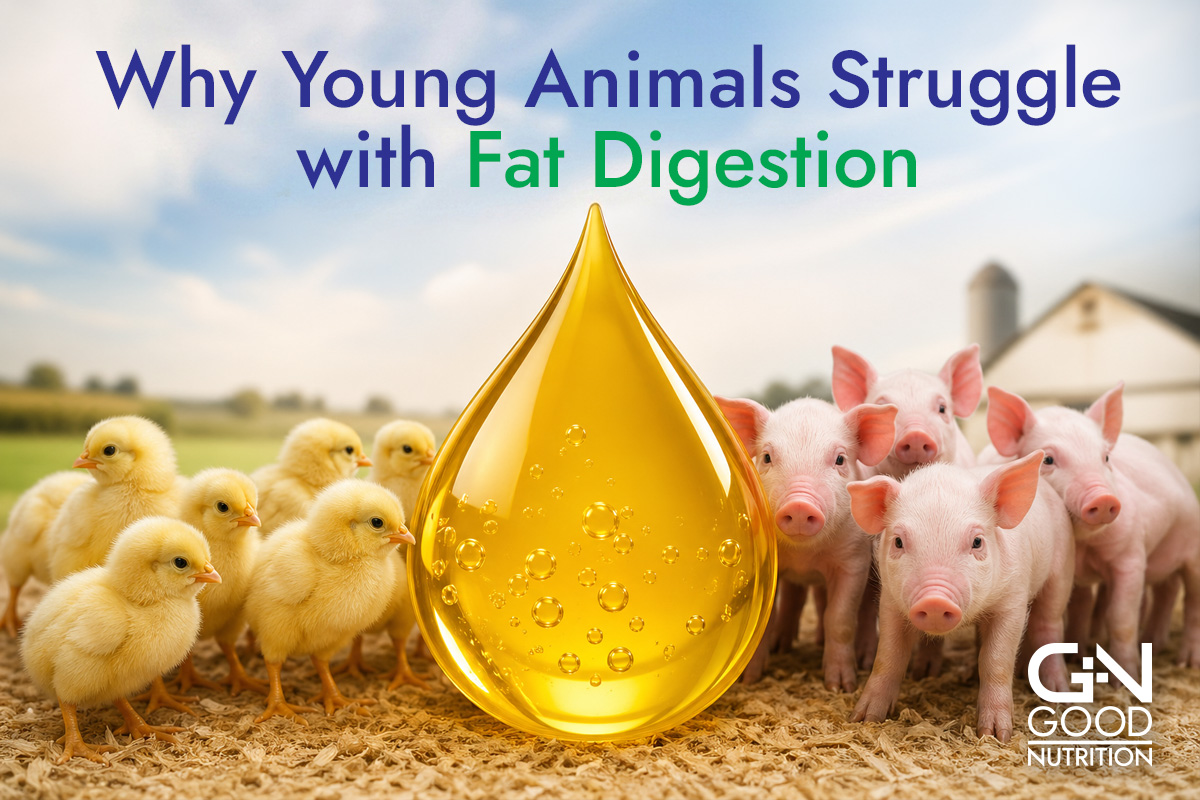
In the early stages of life, young animals face a hidden nutritional challenge that often goes unnoticed, their ability to digest fats is naturally limited. This is not a flaw, but a biological reality tied to how their digestive systems develop.
Fat, or lipid, is one of the most energy-dense components in animal feed. It plays a critical role in growth, immunity, and overall performance. However, for fat to deliver its full value, it must first be properly digested and absorbed. In young animals, this process is not yet fully efficient.
The primary reason lies in the underdevelopment of key digestive components. Lipase, the enzyme responsible for breaking down fats, is produced at low levels in young animals. At the same time, bile production, which is essential for emulsifying fats and making them easier to digest, is also limited. Without sufficient bile salts and lipase, fats pass through the digestive system without being fully utilized.
This limitation is especially evident in poultry. In young broilers, the digestive system requires time to mature, typically around 10 to 14 days. During this period, fat digestibility is significantly reduced. As a general guideline, birds under 10 days of age can experience up to a 10 percent reduction depending on fat source and formulation in fat energy utilization.
Figure 14: Influence of broiler age on lipid digestibility.
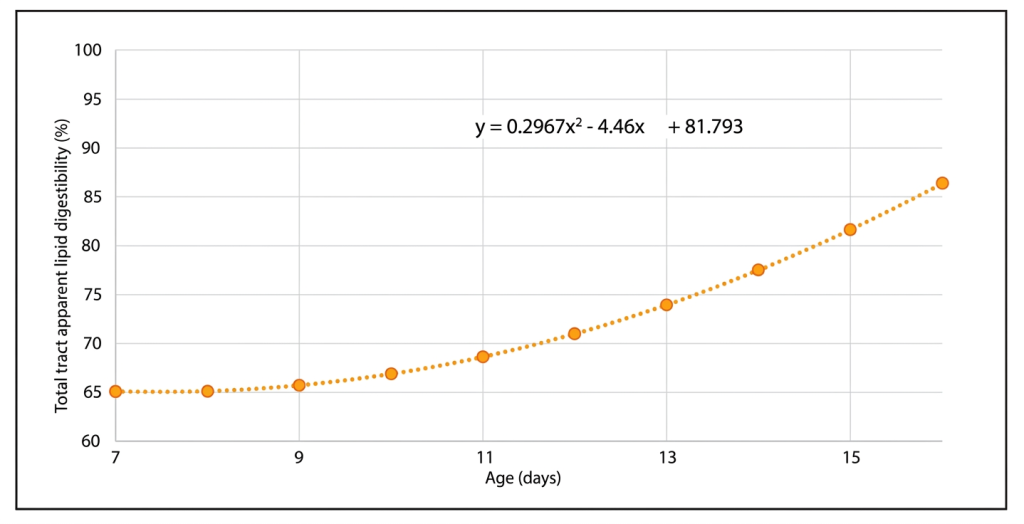
Scientific observations further highlight this gap. The ability of broilers to absorb corn oil improves dramatically from 84 percent in the first week to 95 percent in the second week of life. Similarly, the absorption of more complex fats such as tallow increases from 40 percent to 79 percent over the same period. This shows not only the initial limitation, but also how quickly the system develops once maturity begins.
The challenge is even more pronounced when diets contain saturated fats or high levels of free fatty acids. These types of fats are inherently more difficult to digest, placing additional strain on an already immature digestive system.
A similar pattern is observed in piglets. During the first week after birth or immediately after weaning, pancreatic and intestinal lipase activity remains low. This further reduces the animal’s ability to efficiently utilize dietary fats, limiting the energy they can extract from feed during a critical growth phase.
The consequence of this inefficiency is both biological and economic. When fat digestibility is low, animals require higher levels of dietary energy to meet their needs. This often leads to increased inclusion of energy-rich ingredients, driving up feed costs without guaranteeing optimal absorption.
This is where nutritional strategies become essential. Supporting fat digestion during this early stage can significantly improve energy utilization and overall performance. One such approach is the use of lysolecithin, an emulsifier that enhances the breakdown and absorption of fats even when the animal’s natural systems are not fully developed.
By improving fat digestibility, especially in young animals, producers can bridge the gap between nutritional potential and actual performance. The result is more efficient feed use, better growth outcomes, and a stronger foundation for long term animal health.
In the bigger picture, optimizing early nutrition does more than improve animal performance. It supports a more sustainable and cost-effective production system, ensuring that every unit of feed delivers real value, from farm to table.
References:
- Lipids: Part 2 – peroxidation and formulation in broiler diets (January 2024) Asian Poultry Magazine
- Broiler feed tips to select the right fats, oils (20 February 2017) https://www.wattagnet.com/broilers-turkeys/article/15520658/8-broiler-feed-tips-to-select-the-right-fats-oils-wattagnet
- Oil and fat in poultry nutrition (July 2005) https://www.scielo.br/j/rbca/a/YBL7TjGmb46VJC5L6PR3qxy/?format=pdf&lang=en#:~:text=The%20capability%20to%20absorb%20corn,physiological%20ability%20to%20absorb%20fat.
- Fat nutrition and metabolism in piglets: a review (3 October 2003) https://www.sciencedirect.com/science/article/abs/pii/S0377840103001718
- Overview of Fat Digestion and Metabolism in Dairy Cows (8 January 2007) https://www.thecattlesite.com/articles/793/overview-of-fat-digestion-and-metabolism-in-dairy-cows