For years, many nutritionists believed emulsifiers were only useful when large amounts of oil or fat were added into animal feed.
After all, if there is very little added fat in the diet, what exactly is there to emulsify?
But newer research is challenging that assumption.
Today, multiple studies show that lysolecithin continues to improve animal performance even in low-fat formulations, and even in diets with no added oil at all.
That matters more than ever in modern feed production, where rising raw material costs are pushing formulators to reduce energy density and optimize every nutrient more efficiently.
The surprising part is this:
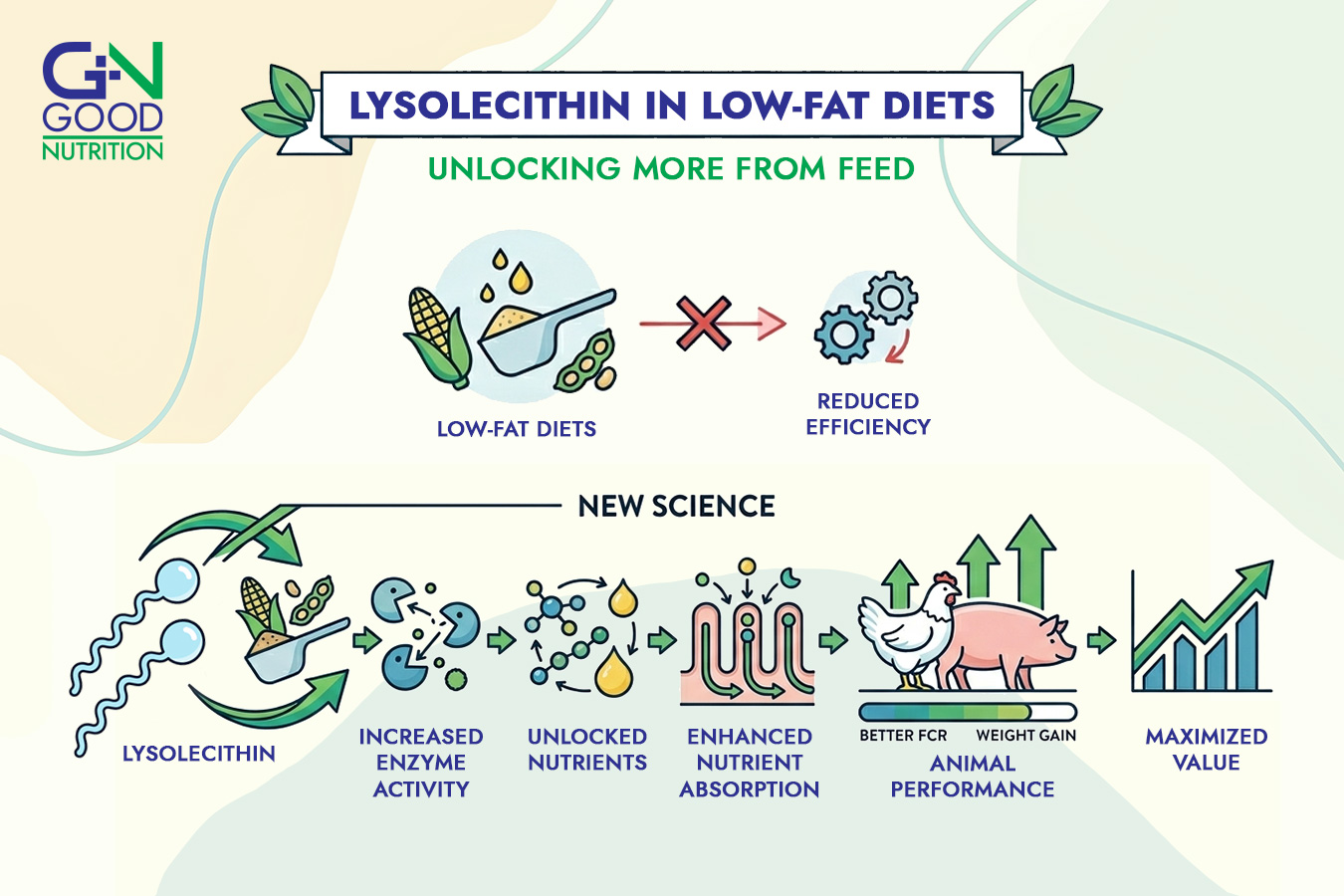
Lysolecithin is not only helping animals digest fat. It is helping them absorb nutrients more effectively overall.
The Hidden Fat Already Inside Feed Ingredients
Even when no oil is added to feed, ingredients like corn and soybean meal still naturally contain fat.
Corn typically contains around 3 to 4 percent fat, while soybean meal contains smaller amounts trapped within fiber and protein structures.
The challenge is that this “intact fat” is harder for animals to access and digest compared to free added oils.
Young animals especially struggle with this because their digestive systems are still immature. They naturally produce lower levels of bile salts and lipase enzymes, both of which are essential for breaking down fats.
This creates an invisible bottleneck inside the digestive tract.
The nutrients are present in the feed, but the animal cannot fully access them.
This is where lysolecithin becomes important.
More Than Just an Emulsifier
Lysolecithin works by reducing the surface tension between fats and water inside the gut, helping fats form tiny droplets called micelles. These smaller droplets become easier for digestive enzymes to attack and absorb.
But researchers are now discovering that its effects go far beyond fat digestion.
A 2025 study published in Animals found that broilers supplemented with lysolecithin showed improvements not only in fat digestibility, but also in protein absorption, gut structure, and overall growth performance, regardless of whether the birds were fed normal-fat or low-fat diets.
The results were significant.
Protein digestibility typically improved by around 5 to 10 percent. While fat digestibility improved by 3 to 6 percent compared to unsupplemented diets.
Intestinal lipase activity rose substantially, reporting 50 to 70 percent in certain intestinal segments under the conditions of specific trials.
Researchers also observed healthier intestinal villi, the tiny finger-like structures responsible for nutrient absorption. In some cases, villus height increased by 5 to 15 percent, effectively expanding the animal’s absorptive surface area.
In simple terms, the gut became more efficient at extracting nutrients from the same feed.
Performance Improvements Even Without Added Oil
One of the most interesting findings came from studies using diets with no added fat at all.
A 2021 trial evaluated broilers fed only the natural fats present in corn and soybean meal. Even under those conditions, birds receiving lysolecithin achieved:
- 4 to 5 percent higher body weight gain
- 4 to 5 percent better feed conversion ratio (FCR)
That is a meaningful improvement in commercial production.
Researchers suggested that lysolecithin may actually become more valuable in these lower-fat formulations because the intact fats inside raw materials are more difficult to digest than free oils.
In other words, the harder the nutrients are to access, the more important digestive efficiency becomes.
Why Gut Health Matters Too
Another reason lysolecithin continues to show value is its effect on intestinal health.
Modern production animals face constant stress from rapid growth, heat, disease pressure, and feed changes. All of these factors can damage the intestinal lining and reduce nutrient absorption.
Studies show lysolecithin may help strengthen intestinal integrity by supporting epithelial cell development and improving the structure of the gut wall.
Researchers also observed reductions in abdominal fat deposition and lower blood triglyceride levels in supplemented animals. This suggests nutrients were being utilized more efficiently for growth rather than stored inefficiently as body fat.
For producers, that means improved feed efficiency and potentially better economic returns from the same diet.
A Bigger Shift in Feed Nutrition
The role of lysolecithin is gradually evolving.
It is no longer viewed simply as an additive used when extra oil is included in feed.
Instead, it is becoming part of a broader nutritional strategy focused on improving nutrient utilization, gut efficiency, and feed cost optimization.
That shift is important because modern feed formulation is no longer just about adding nutrients.
It is about helping the animal unlock more value from the nutrients already present.
And in an industry where margins are constantly under pressure, even small improvements in digestibility and feed conversion can have a major impact across thousands of animals.
The Bottom Line
The science is becoming increasingly clear.
Lysolecithin remains effective even in low-fat or no-added-oil diets because its benefits extend far beyond emulsification alone.
It helps animals:
- Access hard-to-digest fats already present in raw materials
- Improve protein and energy utilization
- Enhance gut structure and digestive efficiency
- Increase digestive enzyme activity
- Convert nutrients into growth more efficiently
In practical terms, this means better performance from the same feed, even in cost-reduced formulations.
And in today’s livestock industry, efficiency is everything.