Feed costs continue to be one of the largest expenses in livestock production. As nutritionists and producers look for ways to improve efficiency without compromising animal performance, lysolecithin has emerged as a valuable tool in modern feed formulation.
Many people think of lysolecithin as simply another feed additive. In reality, its greatest value comes from what it allows nutritionists to remove or reduce from a diet.
By improving fat emulsification, nutrient digestion, and energy utilization, lysolecithin enables feed formulators to lower the inclusion of more expensive ingredients while maintaining growth performance, feed conversion, and animal health. This creates cost savings that can accumulate significantly over time.
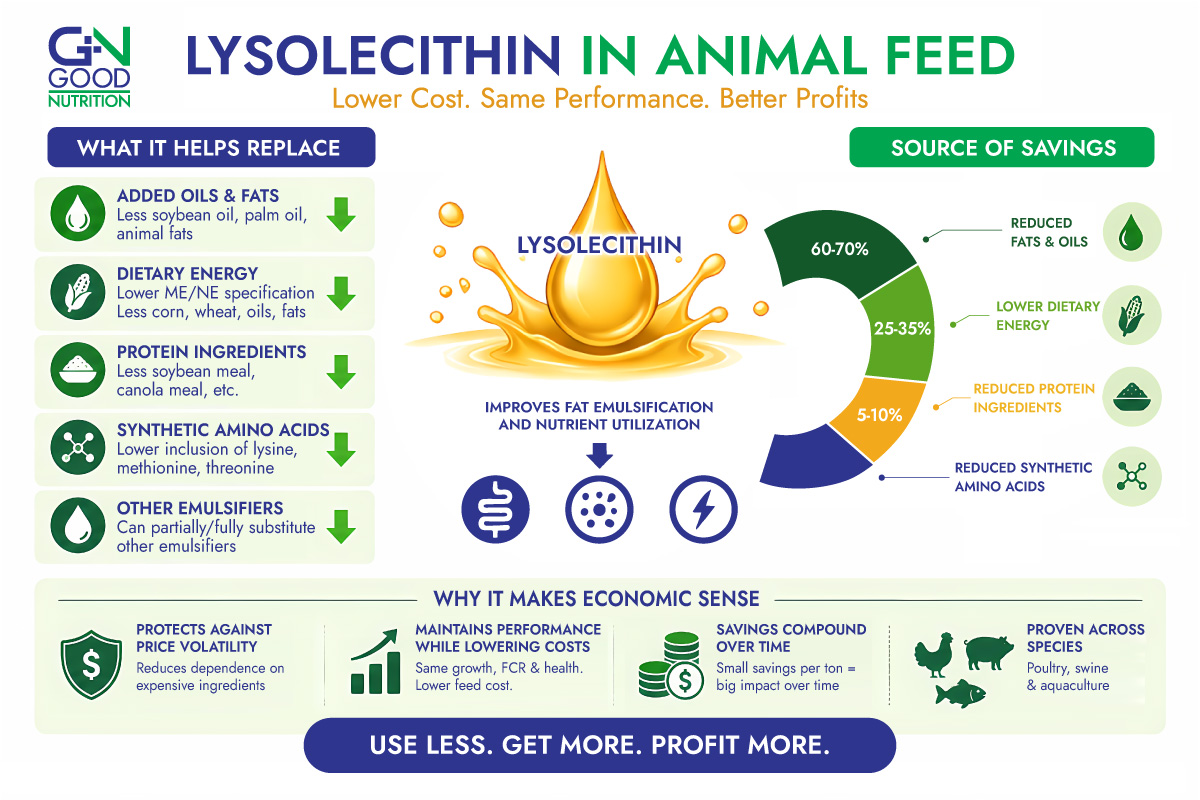
What Does Lysolecithin Replace in Animal Feed?
1. Added Oils and Fats: The Biggest Opportunity
The most common and economically important application of lysolecithin is reducing the need for added fats and oils.
Fats are a valuable source of energy, but animals must first digest and absorb them efficiently. Lysolecithin acts as a powerful emulsifier, breaking fats into smaller droplets and increasing the surface area available for lipase enzymes. This improves fat hydrolysis and fatty acid absorption in the gastrointestinal tract.
As a result, nutritionists and formulators may:
- Reduce added vegetable oils such as soybean oil and palm oil
- Lower inclusion rates of animal fats such as tallow and lard
- Utilize lower-cost fat sources
- Include less digestible fats without negatively affecting performance
For example, a broiler diet containing 3% soybean oil can often be reformulated with less oil while still delivering the same usable energy for growth.
2. Dietary Energy: Unlocking the “Energy Matrix”
One of the most powerful benefits of lysolecithin is its ability to function as an energy matrix ingredient.
In practical terms, this means nutritionists formulate diets with lower baseline energy levels and rely on lysolecithin to recover part of that energy through improved nutrient utilization.
Typical matrix values range from:
- 50 to 100 kcal/kg of feed
- Potentially higher depending on the formulation and supporting research
This allows feed formulators to reduce expensive energy-contributing ingredients such as:
| Ingredient | Cost Impact |
|---|---|
| Corn | High |
| Wheat | Moderate to High |
| Vegetable Oils | Very High |
| Animal Fats | High |
By lowering metabolizable energy (ME) and net energy (NE) specifications while maintaining performance, feed mills can significantly reduce formulation costs.
3. Protein Ingredients: Smaller but Meaningful Savings
Recent research suggests that lysolecithin may also improve protein utilization.
Studies have shown benefits such as:
- Improved amino acid digestibility
- Enhanced protein absorption
- Better gut health that supports nutrient uptake
Because of this, nutritionists can sometimes apply a small amino acid matrix and slightly reduce high-cost protein ingredients such as:
- Soybean meal
- Canola meal
- Other protein concentrates
Although protein-related savings are typically smaller than energy savings, they still contribute meaningful reductions to overall feed costs.
4. Synthetic Amino Acids
In precision nutrition programs, lysolecithin may also support reductions in synthetic amino acids.
Depending on available digestibility data and supplier recommendations, nutritionists may assign digestible amino acid matrix values for:
- Lysine
- Methionine
- Threonine
This allows for slight reductions in synthetic amino acid inclusion rates while maintaining nutritional requirements. The savings may be modest, but they become significant when multiplied across large production volumes.
5. Other Emulsifiers and Digestibility Enhancers
Feeds sometimes contain lecithin, synthetic emulsifiers, or other surfactants to improve fat digestion.
Lysolecithin can partially or fully substitute these ingredients because of its superior emulsification capabilities. Its’ lysophospholipid structure not only improves fat digestion but also enhances membrane fluidity in intestinal epithelial cells, helping animals absorb nutrients more efficiently.
Where Do the Biggest Savings Come From?
Research across poultry, swine, and aquaculture consistently shows that most economic benefits come from two areas:
| Source of Savings | Relative Contribution |
|---|---|
| Reduced fats and oils | 60-70% |
| Lower dietary energy specification | 25-35% |
| Reduced protein ingredients | 5-10% |
| Reduced synthetic amino acids | Small but consistent |
This is not surprising because fats and oils are often among the most expensive ingredients in feed formulations. Even small reductions can generate substantial financial returns. The relative proportions depend on species, diet structure and local ingredient prices.
Why Is Lysolecithin Economically Sustainable Long-Term?
Protection Against Volatile Ingredient Prices
Feed ingredient markets are notoriously unpredictable.
When soybean oil prices rise, palm oil becomes expensive, corn prices increase, or global commodity markets tighten, feed costs can quickly erode profitability.
Because lysolecithin reduces dependence on expensive fats and improves utilization of lower-cost alternatives, it acts as a buffer against market volatility. This becomes increasingly valuable during periods of inflation and supply uncertainty.
Maintaining Performance While Lowering Costs
The most compelling benefit of lysolecithin is not necessarily improved performance.
The stronger value proposition is:
Maintain the same performance while spending less on feed.
By improving nutrient utilization, lysolecithin allows producers to reduce feed costs without sacrificing:
- Growth rate
- Feed conversion ratio (FCR)
- Animal health
- Overall production efficiency
When performance remains stable, the savings become direct improvements in profit margin rather than trade-offs between cost and productivity.
Savings That Compound Over Time
The financial impact becomes even more significant when viewed over multiple production cycles.
Consider a commercial poultry operation producing 10,000 tons of feed annually.
Depending on local ingredient prices and applied matrices, commercial case study often report savings in the range of US$25 to US$50 per ton of feed with lysolecithin inclusion:
- Annual savings = US$250,000 to US$500,000
- Five-year savings = US$1.25 million to US$2.5 million
These savings compound because every production cycle benefits from the same reduction in formulation costs while maintaining performance.
Natural Origin and Regulatory Stability
Another advantage is its source.
Lysolecithins are derived from hydrolyzed soy lecithin, making them naturally sourced feed ingredients.
This provides several long-term advantages:
- Regulatory stability
- Consumer acceptance
- Reduced concerns over synthetic additives
- Greater compliance confidence across different markets
As regulations surrounding feed additives continue to evolve globally, naturally derived ingredients are likely to become even more valuable.
Additional Value During Heat Stress
Heat stress presents a recurring challenge in livestock production.
During warmer months, nutritionists often increase dietary fat levels to maintain energy intake while reducing heat production from digestion.
Lysolecithin improves the utilization of these added fats, making energy delivery more efficient and creating a seasonal economic advantage that repeats year after year.
Why Formulation Strategies Differ by Species
The amount of energy, fat, or protein that can be removed depends on several factors:
| Factor | Impact |
|---|---|
| Species | Broilers, layers, piglets, sows, shrimp, and fish all have different nutritional requirements |
| Fat Source | Digestibility differs between vegetable and animal fats, as well as saturated and unsaturated fats |
| Matrix Value | Product research determines safe reduction levels |
| Production Stage | Growth, maintenance, and reproduction stages require different nutritional approaches |
Because of these differences, successful lysolecithin application is never a one-size-fits-all solution. Feed formulations must be optimized according to species, production goals, and available research data.
The Commercial Value Proposition
For feed manufacturers and nutrition companies, the strongest message is not simply that lysolecithin improves performance.
The more compelling story is that it helps reduce feed costs while maintaining performance.
This matters because:
- Feed mills are under constant pressure to lower formulation costs.
- Producers cannot afford to compromise growth or FCR.
- Commodity markets remain volatile.
- Proven performance maintains confidence throughout the production chain.
When all four challenges are addressed simultaneously, lysolecithin becomes more than a feed additive. It becomes a strategic business tool.
Conclusion: More Than an Additive
Lysolecithin’s long-term value comes from its ability to improve nutrient utilization while allowing nutritionists to strategically reduce expensive feed ingredients.
The result is a combination of:
- Immediate feed cost savings
- Long-term cumulative economic benefits
- Protection against ingredient price volatility
- Consistent animal performance
- Regulatory confidence through natural sourcing
For an industry facing ongoing pressure from rising feed costs and fluctuating commodity prices, lysolecithin represents more than a nutritional enhancement. It is a practical and sustainable strategy for improving profitability and operational efficiency over the long term.
Research across poultry, swine, and aquaculture production systems continues to demonstrate the economic value of lysolecithin when used as part of a well-designed feed formulation strategy.