Supplementing fats needs careful consideration due to their high cost and potential negative impacts:
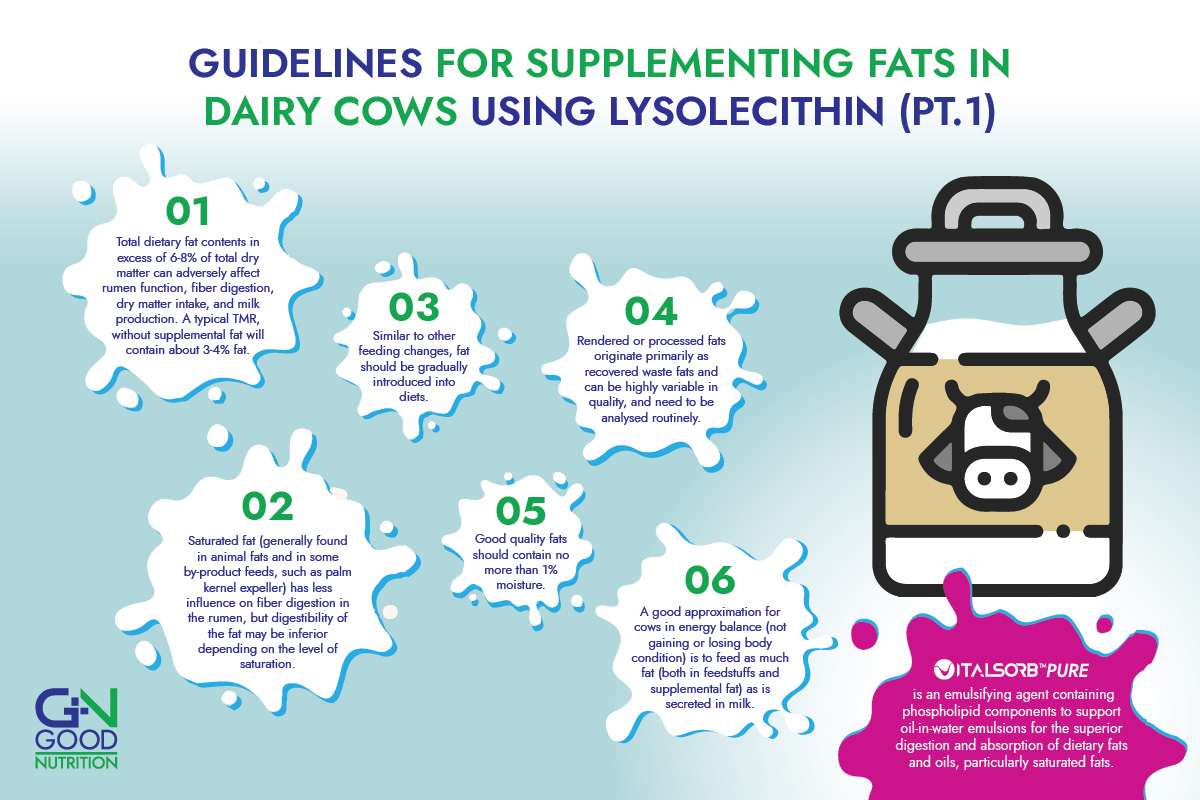
1. Total dietary fat contents in excess of 6-8% of total dry matter can adversely affect rumen function, fiber digestion, dry matter intake, and milk production. A typical TMR, without supplemental fat will contain about 3-4% fat.
2. Saturated fat (generally found in animal fats and in some by-product feeds, such as palm kernel expeller) has less influence on fiber digestion in the rumen, but digestibility of the fat may be inferior depending on the level of saturation.
3. Similar to other feeding changes, fat should be gradually introduced into diets.
4. Rendered or processed fats originate primarily as recovered waste fats and can be highly variable in quality, and need to be analysed routinely.
5. Good quality fats should contain no more than 1% moisture. 6. A good approximation for cows in energy balance (not gaining or losing body condition) is to feed as much fat (both in feedstuffs and supplemental fat) as is secreted in milk.
Vitalsorb™ Pure is an emulsifying agent containing phospholipid components to support oil-in-water emulsions for the superior digestion and absorption of dietary fats and oils, particularly saturated fats.