
Guidelines For Rearing Calves With Milk Replacers Part 3

Guidelines for rearing calves with milk replacers using lysolecithin from GN Good Nutrition.

Continuing our series of farmer-adopted guidelines, we’re emphasising the importance of these practices which have proven to have a significant impact on lifetime performance. With our Vitalsorb Pure lysolecithin, read on to know more how it plays a part in the process.

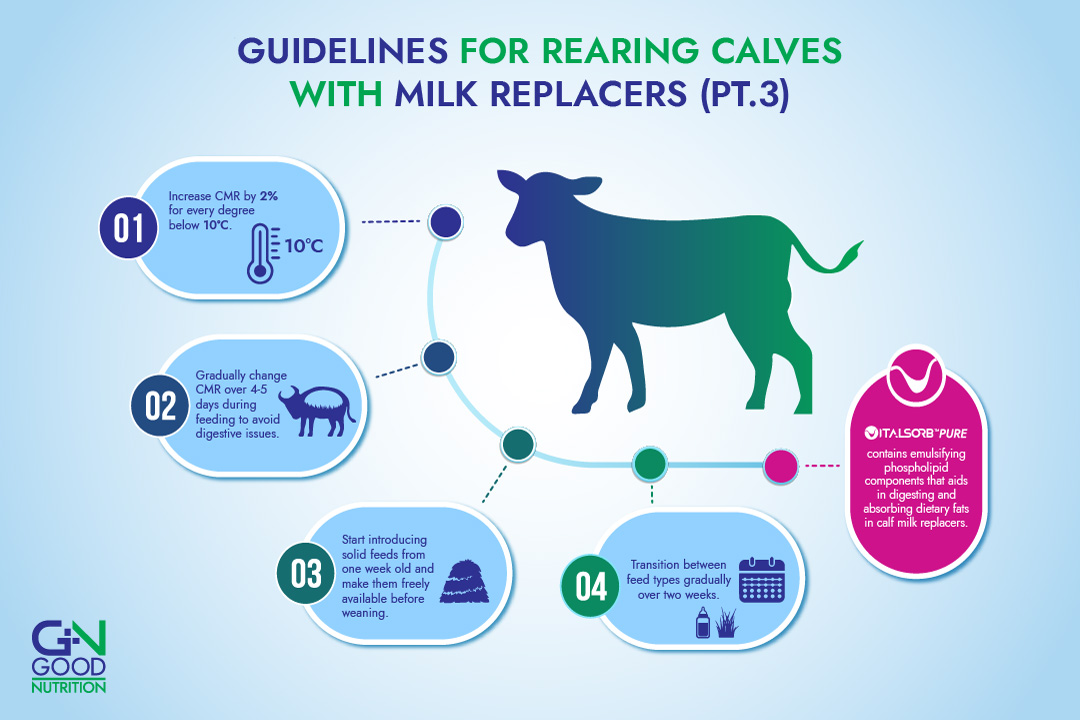
1. A rule of thumb is to increase the amount of CMR by 2% for every degree below 10°C.

2. If you change CMR during feeding, do it gradually over 4-5 days to prevent nutritional scours and digestive upset.

3. Solid feeds (forages and concentrates) should be introduced from one week of age and be freely available before weaning.

4. Gradual transitions between feed types should occur over two weeks.

Vitalsorb™ Pure is an emulsifying agent containing phospholipid components to support oil-in-water emulsions for the superior digestion and absorption of dietary fats and oils, particularly saturated fats.


More articles
Animal Farming-Challenges-and-Growth
Farming and Animal Nutrition in 2026: Industry Status, Challenges, and Growth Drivers
In 2026, global agriculture faces the dual challenge of meeting rising food demand under intense climate and economic pressures while adhering to strict sustainability standards. In this complex environment, animal nutrition has become a strategic lever for productivity, resilience, and environmental responsibility.
Lysolecithin Cost Benefits
Lysolecithin in Animal Feed: What It Replaces and Why It Makes Economic Sense
Feed costs continue to be one of the largest expenses in livestock production. As nutritionists and producers look for ways to improve efficiency without compromising animal performance, lysolecithin has emerged as a valuable tool in modern feed formulation.