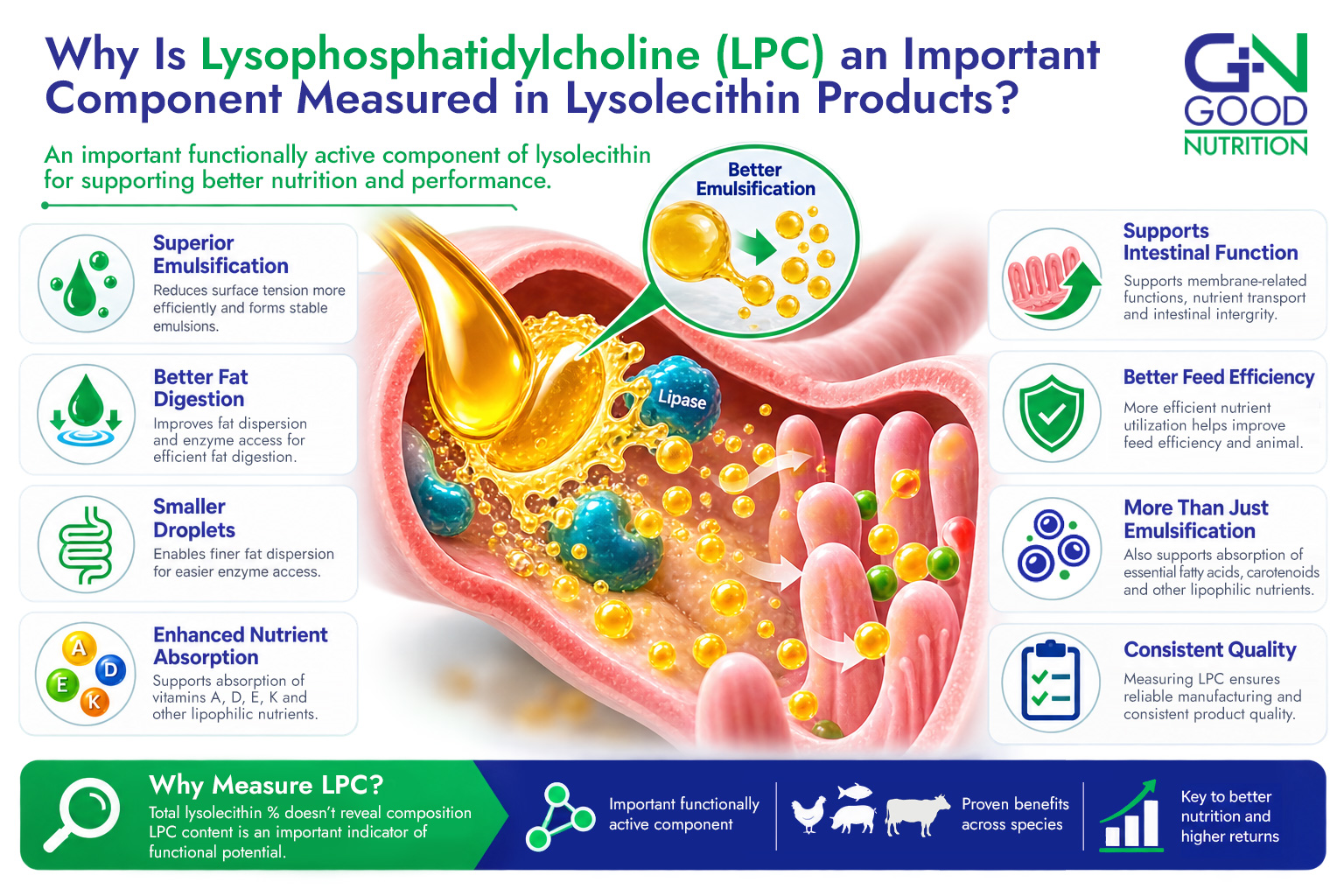

When discussing fat digestion and absorption in animal nutrition, micelles play a silent yet critical role. Understanding how micelles work helps nutritionists and feed formulators choose the right emulsifiers like lysolecithin to improve nutrient uptake, feed efficiency, and animal performance.
The Science Behind Micelles
A micelle is an aggregate of surfactant or amphipathic lipid molecules dispersed in a liquid, forming a colloidal suspension, a stable mixture with insoluble particles permanently dispersed in another substance.
In a typical oil-in-water micelle, the hydrophilic (“water-loving”) head groups of the molecules face the surrounding water, while the hydrophobic (“water-repelling”) tails cluster at the center. This arrangement allows oils and fats to remain evenly dispersed in an aqueous environment.
In contrast, inverse micelles form in non-polar media, with hydrophilic heads inside and hydrophobic tails extending outward. The structure a micelle takes; spherical, lamellar, cubic, or hexagonal, depends on the properties of the emulsifier, such as its hydrophilic-lipophilic balance (HLB) and molecular geometry.
Micelles in Fat Digestion and Absorption
Micelles are vital to lipid digestion, as they serve as the transport carriers for fat digestion products like monoglycerides, free fatty acids, and fat-soluble vitamins. Being water soluble, micelles enable these otherwise insoluble components to move efficiently toward the intestinal wall for absorption.
Here’s how the process typically works:
1. Emulsification – Bile salts or added emulsifiers (e.g., lysolecithin) break dietary fats into tiny droplets, increasing surface area for enzyme action.
2. Micelle Formation – The products of fat digestion combine with bile salts and emulsifiers to form mixed micelles.
3. Absorption – Micelles travel to the intestinal membrane, where they disintegrate, releasing their contents for absorption by passive diffusion.
4. Recycling – Bile salts are reabsorbed and reused in continuous emulsification cycles, a process known as bile recycling.
Micelle Efficiency and Species Differences
Not all species form micelles equally. For example, shrimp lack a bile secretion system, which limits their ability to form stable micelles. This leads to:
• Less efficient fat emulsification
• Lower lipid absorption
• Reduced hepatopancreas function and compromised growth performance
In such species, supplementing feeds with efficient emulsifiers like lysolecithin can compensate for this natural limitation, enhancing nutrient absorption and gut health.