Every kilogram of feed is an investment. The more efficiently a cow converts that feed into milk or meat, the greater the return for the farmer. A key part of that efficiency comes from the billions of microorganisms living inside the rumen.
Understanding how these microbes use nitrogen helps explain why Slow Release Urea (SRU) is gaining attention in modern ruminant nutrition.
The rumen: Nature’s fermentation chamber
A common misconception is that cattle have four stomachs. In reality, they have one stomach divided into four specialized compartments: the rumen, reticulum, omasum and abomasum. Together, these compartments allow ruminants to digest fibrous feeds that monogastric animals cannot.
Of these four compartments, the rumen is by far the largest and most important.
In a mature dairy cow, the rumen can hold up to 150 litres, occupying nearly three quarters of the abdominal cavity. It acts as a large fermentation chamber where feed is continuously mixed with saliva and billions of microorganisms that break down plant material.
Unlike humans, cattle rely mainly on their rumen microbes rather than their own digestive enzymes to convert feed into usable nutrients.
Figure 1: Ruminant stomach.
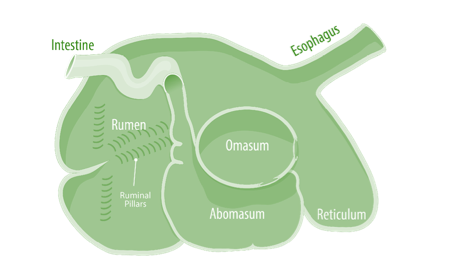
Mississippi State University
Feeding the microbes first
Every time a cow eats, it is actually feeding an enormous microbial population living inside the rumen.
This microbial community includes bacteria, protozoa, anaerobic fungi and archaea. Together they form one of the most complex microbial ecosystems found in nature. Bacteria dominate this ecosystem, reaching populations of 10^10 to 10^11 cells per millilitre of rumen fluid.
Their job is to break down fibre, starch and other feed components into nutrients the animal can use.
During fermentation, they produce volatile fatty acids (VFAs), mainly acetate, propionate and butyrate. These VFAs become the cow’s primary energy source and support milk production, growth and overall productivity.
Nitrogen is just as important as energy
Energy alone is not enough for rumen microbes to grow.
Like all living organisms, they also require nitrogen to build proteins and reproduce.
Ruminants do not have a direct amino acid requirement in the same way humans do. Instead, they depend on a nitrogen supply that can be converted into microbial protein.
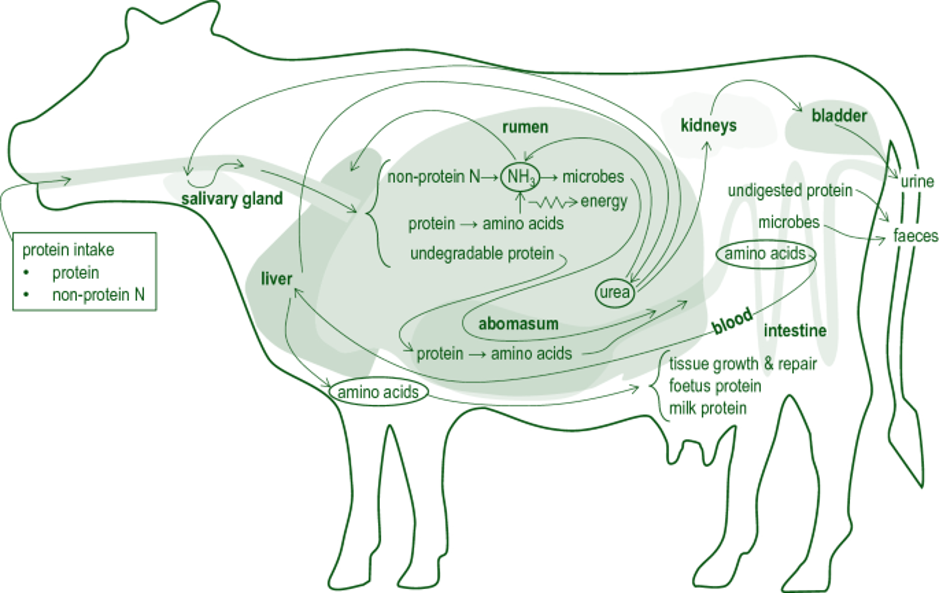
Rumen microbes break down dietary protein into ammonia and use this nitrogen, together with fermentable carbohydrates, to build microbial protein. Once these microbes leave the rumen, they are digested in the small intestine and become one of the animal’s most valuable sources of high quality protein. In fact, microbial protein supplies at least half of the building blocks needed for milk and meat production.
Timing makes all the difference
Providing nitrogen alone is not enough. Microbes also need an adequate supply of fermentable carbohydrates at the same time. Think of it like building a house. Nitrogen provides the bricks, while energy provides the workers who assemble them. Without workers, the bricks simply pile up and go unused.
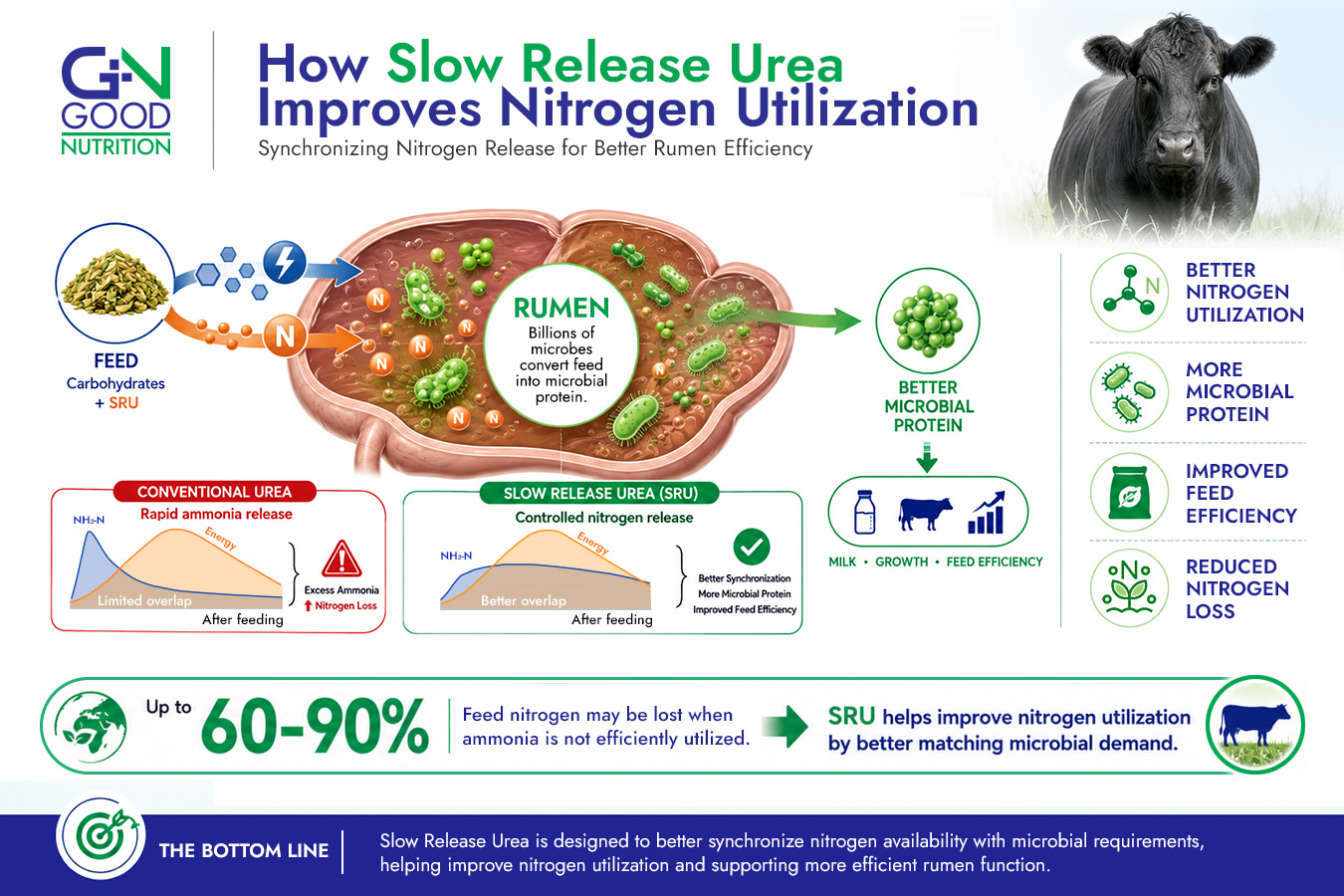
The same thing happens in the rumen. Nitrogen supply works well when energy is available at the same time. If nitrogen is released faster than microbes can use it, excess ammonia accumulates instead of being converted into microbial protein.
Figure 1: Protein digestion in ruminants[i].
SpringerLink
[i] The Ruminant: Life History and Digestive Physiology of a Symbiotic Animal (21 May 2020) https://link.springer.com/chapter/10.1007/978-3-030-46060-0_2
Where conventional urea falls short
Feed-grade urea has long been used as a non-protein nitrogen source because rumen microbes do not distinguish between nitrogen from protein and nitrogen from urea. Approximately 90% of rumen bacterial species use ammonia as their primary nitrogen source, while cellulolytic bacteria rely exclusively on ammonia for growth.
However, conventional urea dissolves very quickly after entering the rumen.
An enzyme called urease, produced by rumen bacteria, rapidly converts urea into ammonia and carbon dioxide.
This process is extremely fast. Urease accelerates the reaction approximately 10^14 times faster than it would occur naturally, allowing most conventional urea to be hydrolysed within 30 minutes to two hours after feeding.
If sufficient fermentable energy is not available during this period, microbes cannot capture all of the released ammonia.
When ammonia goes unused
Ammonia that is not incorporated into microbial protein does not simply disappear.
Instead, it is absorbed through the rumen wall into the bloodstream, transported to the liver and converted back into urea.
Some of this urea is recycled back into the rumen through saliva or across the rumen wall, while the remainder is excreted in urine and faeces.
Research has shown that 60 to 90% of feed nitrogen may ultimately be lost through excretion, representing both an economic loss for the producer and an environmental concern.
How Slow Release Urea changes the equation
This is where Slow Release Urea offers a different nutritional approach.
Instead of releasing all its nitrogen immediately, SRU is designed to release ammonia gradually over time.
By slowing nitrogen release, SRU helps better match the availability of ammonia with the gradual release of energy from feed ingredients.
As a result, rumen microbes have more time to capture ammonia efficiently, produce microbial protein, improve nitrogen utilization and reduce nitrogen losses.
The objective is not to provide more nitrogen, but to improve how efficiently existing nitrogen is used.
Bringing it back to the farm
When rumen microbes work efficiently, the benefits extend throughout the production system.
Improved microbial protein synthesis can support better feed efficiency, more effective fibre digestion, improved utilization of dietary nutrients, reduced nitrogen losses and better overall performance.
For nutritionists, this means formulating diets that better synchronize nitrogen and energy supply.
For farmers, it means making better use of every kilogram of feed.
Key takeaways
The rumen is a highly specialized fermentation chamber powered by billions of microorganisms.
These microbes require both nitrogen and fermentable energy at the right time to produce microbial protein efficiently.
Conventional urea provides a rapid source of nitrogen, its fast release can lead to ammonia losses when microbial demand is exceeded.
Slow Release Urea is designed to better synchronize nitrogen availability with microbial requirements, helping improve nitrogen utilization and supporting more efficient rumen function.