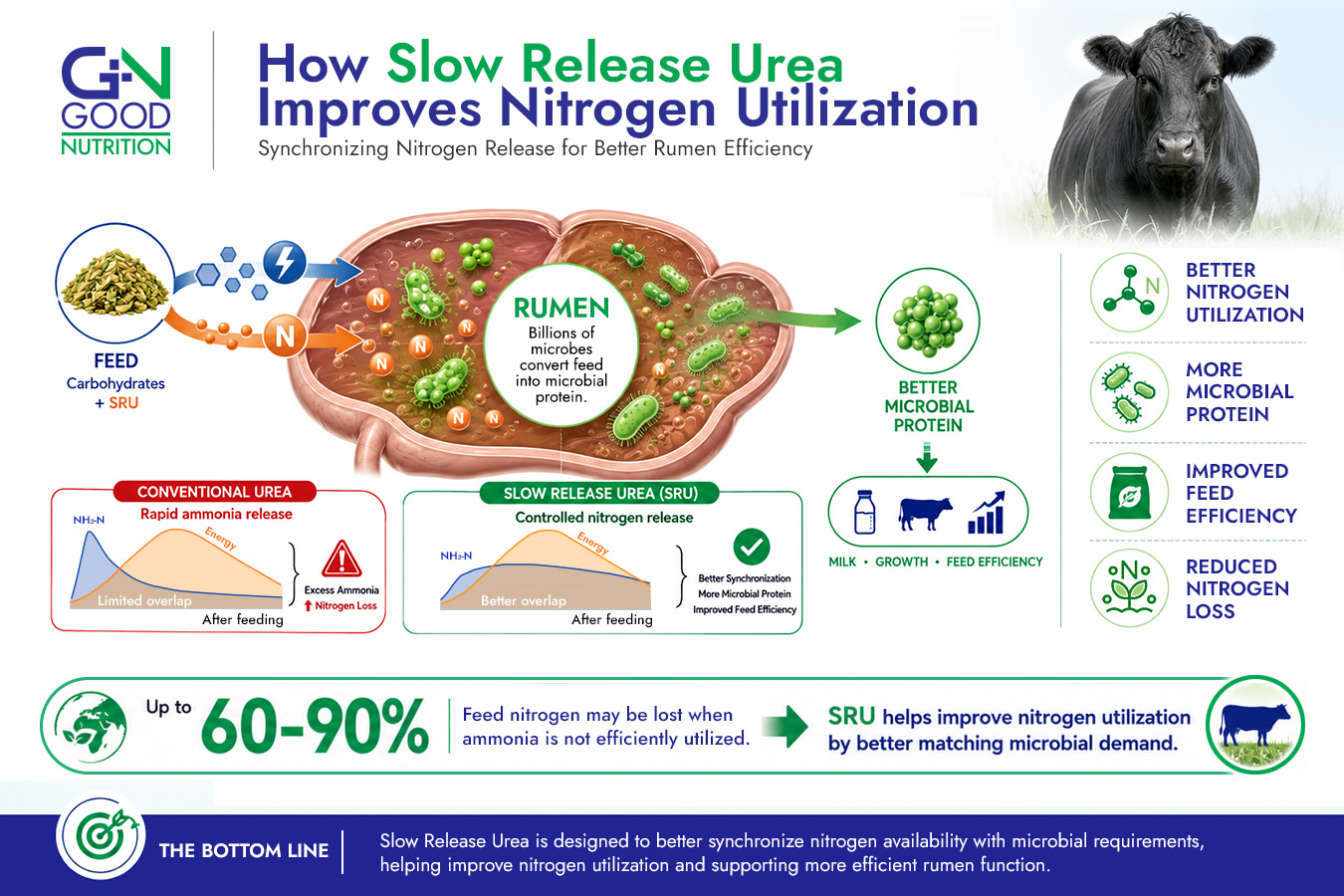
When a cow eats, millions of microbes inside the rumen get to work breaking down feed. These microbes rely on nitrogen, mainly in the form of ammonia, to grow and produce microbial protein, an important source of metabolizable protein for the cow.
But there is one important factor that often gets overlooked: timing.
It is not just about how much nitrogen is available, but how quickly it is released in the rumen.
What Happens with Conventional Urea?
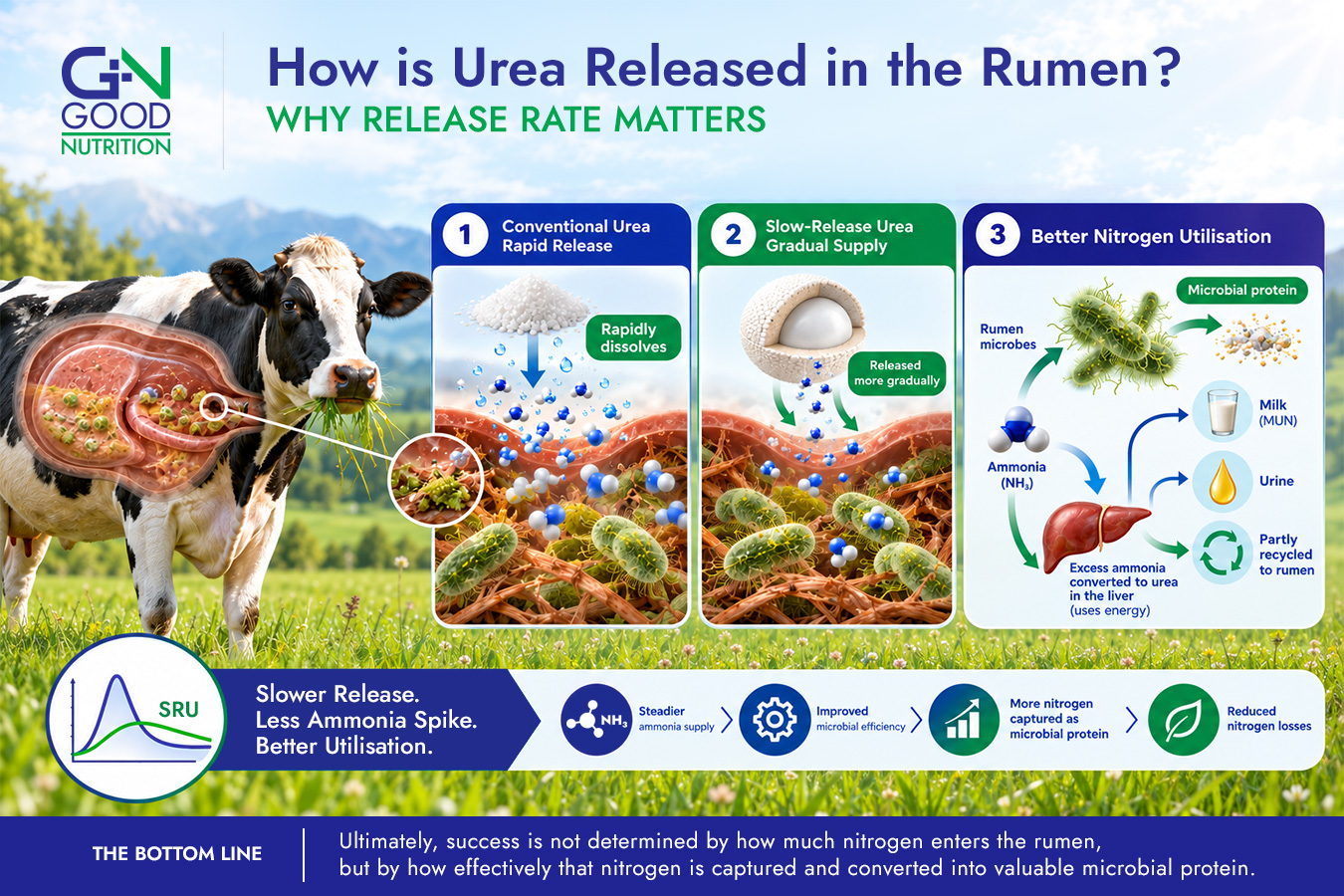
Conventional, or uncoated, urea dissolves and is rapidly hydrolysed once it enters the rumen. Urea hydrolysis can occur rapidly (within 20 minutes), often causing rumen ammonia concentration to rise soon after feeding.
As urea is hydrolysed, ammonia is rapidly released. After feeding, ammonia concentrations in the rumen typically rise sharply within the first hour. The timing of peak rumen ammonia depends on the diet and nitrogen source, but with feed-grade urea, the peak may occur within the first hour after feeding. This can create noticeable fluctuations in rumen ammonia levels after feeding.
The challenge is that rumen microbes can only use ammonia efficiently when adequate fermentable energy is available.
When ammonia is released faster than the microbes can capture, excess ammonia may accumulate in the rumen. Instead of being converted into microbial protein, part of the excess ammonia is absorbed through the rumen wall into the bloodstream.
Why Too Much Ammonia Is a Problem
Once ammonia enters the bloodstream, the liver converts it to urea because excessive ammonia concentrations can be toxic to the animal.
The liver converts the ammonia back into urea, a process that requires energy. This process uses energy that could otherwise support productive functions such as milk production, growth, reproduction, or body-condition maintenance.
Some of this newly formed urea can be recycled back into the rumen, giving the microbes another opportunity to use it. However, some nitrogen is ultimately excreted from the animal.
This nitrogen may be excreted:
- Through urine.
- In milk as milk urea nitrogen (MUN) in dairy cows.
Although urea is often thought of as a waste product, the story is more interesting in ruminants. Cattle can recycle part of this urea back into the rumen, where it can again provide nitrogen for microbial protein synthesis. Even so, nitrogen excreted through urine or milk represents nitrogen that was not captured for productive use.
How Slow Release Urea Changes the Picture
Slow-release urea (SRU) was developed to help to address this timing problem.
Rather than releasing ammonia as rapidly as conventional use, SRU is designed to supply ammonia more gradually. This may better match ammonia availability with microbial nitrogen demand and fermentable-energy supply.
In a study comparing feed-grade urea with slow-release urea in beef steers, conventional urea increased mean ruminal ammonia concentrations by 58% compared with slow-release urea (Taylor-Edwards et al., 2009).
In other words, SRU can slow ammonia release and reduce peak rumen ammonia concentrations when it replaces conventional urea.
By providing a steadier supply of nitrogen, SRU may improve the synchronization between ammonia availability and microbial demand. This may allow a greater proportion of the nitrogen to be captured and converted into microbial protein rather than being lost.
Better Timing Means Better Nitrogen Utilisation
Think of rumen microbes as workers on a construction site.
If all the building materials are delivered in one huge shipment at the start of the day, much of it sits unused and may even go to waste before the workers can use it.
However, if the materials arrive more steadily throughout the day, the workers can keep building with far less waste.
The same principle applies inside the rumen.
By releasing nitrogen more gradually, slow-release urea can help create a more consistent ammonia supply for microbial growth. When correctly formulated into a balanced diet, this may support more efficient nitrogen utilisation and reduced nitrogen losses.
Ultimately, success is not determined by how much nitrogen enters the rumen, but by how effectively that nitrogen is captured and converted into valuable microbial protein.
Slow-release urea should be used as part of a properly balanced ration and according to recommended inclusion rates.
Sources:
Taylor-Edwards, C. C., Hibbard, G., Kitts, S. E., McLeod, K. R., Axe, D. E., Vanzant, E. S., Kristensen, N. B., & Harmon, D. L. (2009). Effects of slow-release urea on ruminal digesta characteristics and growth performance in beef steers. Journal of Animal Science, 87(1), 200-208. https://doi.org/10.2527/jas.2008-0912