When discussing fat digestion in animal nutrition, terms like emulsification, micelles, and critical micelle concentration (CMC) often appear in scientific literature. While these concepts may sound technical, they help explain why lysolecithin is used in feed to support nutrient utilization.
Understanding critical micelle concentration helps explain why lysolecithin can perform better than lecithin in some feeding situations, especially in young animals with immature digestive systems.
What Is Critical Micelle Concentration (CMC)?
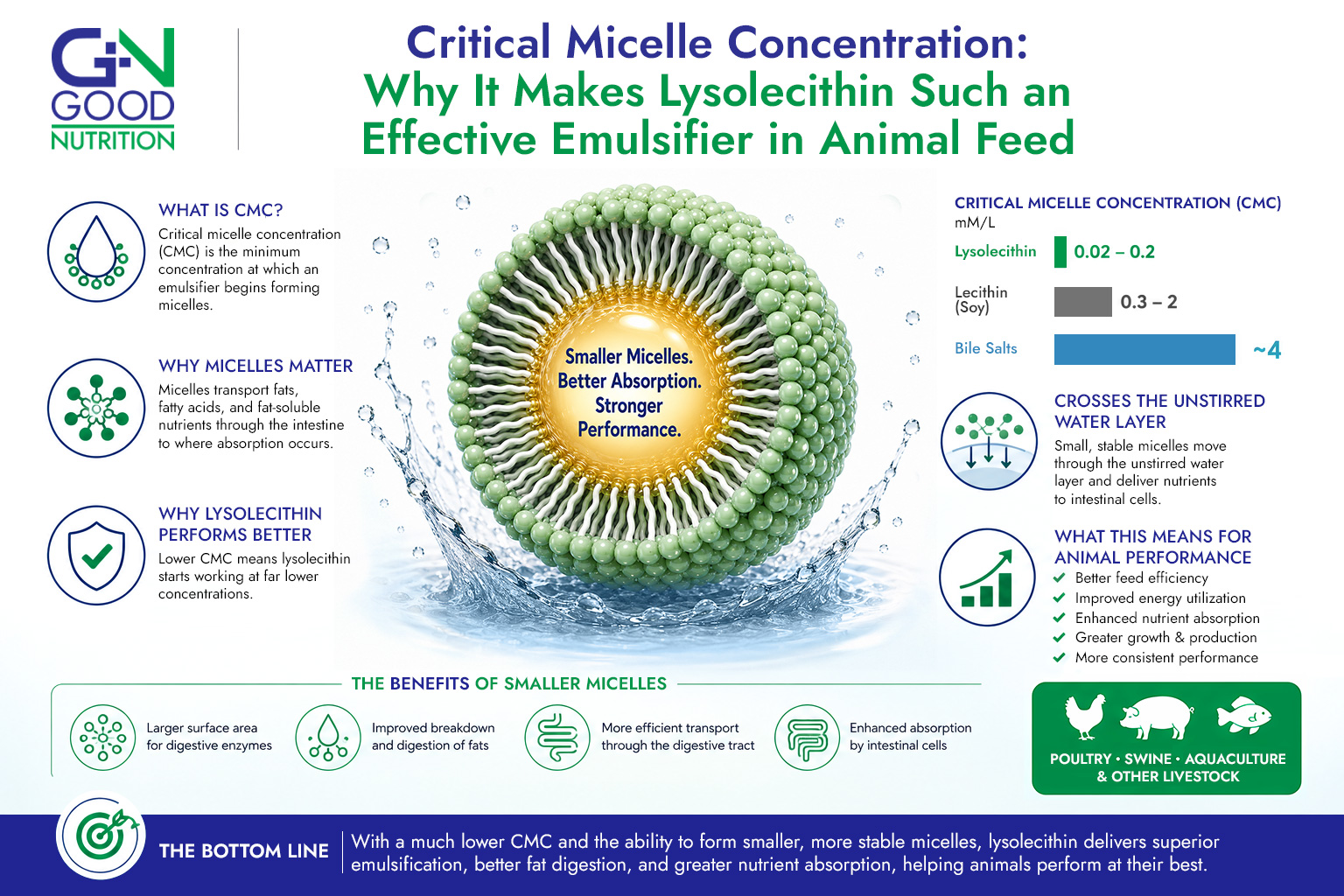
Critical micelle concentration, or CMC, is the concentration at which amphiphilic molecules begin to self-associate into micelles.
Below the CMC, emulsifier molecules remain dispersed individually. Once the CMC is reached, they form micelles that can help solubilize lipids in the digestive system.
In simple terms, a lower CMC means micelles can form at lower concentrations.
This makes CMC one of the most important characteristics when evaluating the efficiency of an emulsifier.
Why Are Micelles Important?
Micelles play a crucial role in fat digestion and nutrient absorption.
After dietary fats are broken down, they are incorporated into mixed micelles to move through the watery environment of the intestine. These tiny carriers transport fatty acids, monoglycerides, fat-soluble vitamins, and other lipophilic nutrients to the intestinal surface, where absorption takes place.
Without efficient micelle formation, valuable nutrients may pass through the digestive tract without being fully absorbed.
Why Lysolecithin Performs Better
One of the reasons lysolecithin is considered an effective emulsifier is its relatively low critical micelle concentration.
Research shows that lysolecithin has a CMC of 0.02 to 0.2 mM/L, compared with approximately 4 mM/L for bile salts, although reported values vary by composition and measurement method. This means lysolecithin can begin forming micelles at concentrations 20 to 200 times lower than bile, allowing it to work far more efficiently.
Compared with conventional phospholipids such as soy lecithin, which have a CMC of 0.3 to 2 mM/L, lysolecithin generally demonstrates greater emulsifying power.
As a result, the emulsification capacity of lysolecithin is approximately five times greater than standard lecithin, making it a highly effective exogenous emulsifier for animal feed.
Smaller Micelles Mean Better Fat Digestion
The benefits of lysolecithin extend beyond simply forming micelles quickly.
It may also contribute to the formation of smaller mixed micelles, and micelle size can influence the digestion and absorption of fats and other fat-soluble nutrients.
Smaller mixed micelles provide several important advantages:
- They can increase the interfacial area available for digestion.
- They may support more efficient fat digestion.
- They can facilitate nutrient movement through the intestinal environment.
- They may improve the delivery of fat-soluble compounds to the intestinal surface.
Simply put, smaller micelles allow animals to extract more nutritional value from every kilogram of feed.
Crossing the Unstirred Water Layer
Before nutrients can enter the intestinal cells, they must first pass through a thin barrier known as the unstirred water layer.
This layer acts as one of the final obstacles between digested nutrients and absorption.
Small, more stable mixed micelles may move through this layer more easily than larger micelles. Once they reach the intestinal surface, they help deliver fatty acids, monoglycerides, and fat-soluble nutrients for absorption by enterocytes.
Micelle size may also influence how efficiently nutrients are taken at the intestinal surface. Smaller micelles generally result in more effective nutrient delivery and improved absorption.
What This Means for Animal Performance
More efficient emulsification and smaller micelles can contribute to better utilization of dietary fat.
Improved fat digestion may help animals extract more energy from the same feed while supporting the availability of fat-soluble vitamins and other lipophilic nutrients.
These improvements can contribute to:
- Potentially better feed efficiency.
- Improved energy utilization.
- Enhanced nutrient absorption.
- Potential support for growth and production performance.
- Consistent performance, particularly in young animals whose natural bile production is still developing.
The Bottom Line
Critical micelle concentration is more than just a laboratory measurement. It is a practical indicator of how efficiently an emulsifier performs inside the animal.
Because lysolecithin generally shows a lower critical micelle concentration than conventional lecithin, it can support micelle formation fat digestion more effectively in some feeding conditions.
This unique property is one of the key reasons lysolecithin is used as a valuable nutritional tool to support feed efficiency, dietary energy utilization, and animal performance across poultry, swine, aquaculture, and other livestock species.
Source:
[1] Enhancing the dietary value of palm oil in the presence of lysolecithin in tiger shrimp, Penaeus monodon (2018) https://krishi.icar.gov.in/jspui/bitstream/123456789/10772/1/Imran%20Aquaculture%20International%20Print%20version1.pdf