
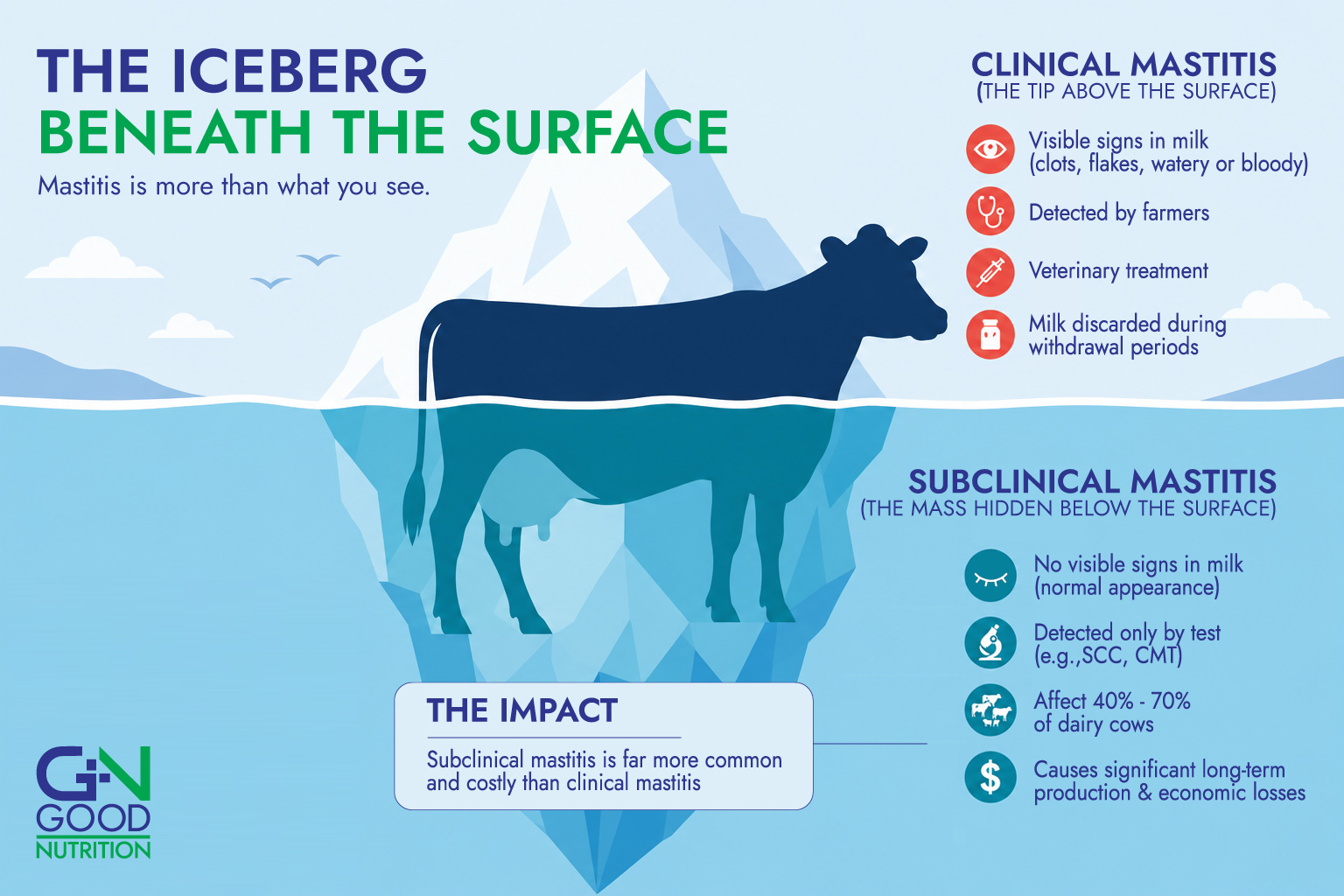
When dairy farmers think about mastitis, they often picture swollen udders, abnormal milk, veterinary treatments, and discarded milk. These visible symptoms are characteristic of clinical mastitis, the form of mastitis that immediately demands attention.
However, what many farms overlook is that the greatest financial losses often come from a much quieter threat: subclinical mastitis.
Unlike clinical mastitis, subclinical mastitis shows no obvious signs. The milk appears normal. The udder appears healthy. The cow continues to enter the milking parlor every day.
Yet beneath the surface, inflammation is reducing milk production, damaging udder tissue, and quietly eroding farm profitability.
Clinical Mastitis vs. Subclinical Mastitis
The primary difference between the two conditions is visibility.
Clinical mastitis presents visible symptoms such as clots or flakes in milk, swollen udders, reduced appetite, fever, and noticeable decreases in milk production. Because the symptoms are obvious, farmers can identify and treat affected cows quickly.
Subclinical mastitis, on the other hand, is largely invisible. There are no obvious physical signs. Detection typically requires monitoring Somatic Cell Count (SCC), California Mastitis Tests (CMT), or milk culturing.
| Feature | Clinical Mastitis | Subclinical Mastitis |
| Visible signs | Yes | No |
| Abnormal milk | Yes | No |
| Udder swelling | Often | Rare |
| Elevated SCC | Yes | Yes |
| Easy to detect | Yes | No |
| Immediate treatment | Usually | Often delayed or missed |
| Main financial impact | Discarded milk, culling, treatment | Long-term milk production losses |
The Surprising Financial Reality
Many farmers assume clinical mastitis is the most expensive form because treatment costs are visible and immediate.
The reality is quite different.
Research consistently shows that subclinical mastitis accounts for approximately 75% to 80% of all mastitis-related economic losses, while clinical mastitis contributes only 20% to 25%.
Clinical mastitis may cost more per individual case, with estimates ranging from USD 128 to USD 586 per case, depending on severity and location. However, subclinical mastitis affects far more cows and often remains undetected for extended periods.
| Metric | Clinical Mastitis | Subclinical Mastitis |
| Cost per case | USD 128-586 | Continuous loss |
| Share of total mastitis losses | 20-25% | 75-80% |
| Visibility | High | Low |
| Main driver of losses | Milk loss and premature culling | Chronic milk yield loss and lost premiums |
The Iceberg Beneath the Surface
Experts often describe mastitis as an iceberg.
Clinical mastitis is the visible tip above the water. Farmers see abnormal milk, call the veterinarian, administer treatments, and discard milk during withdrawal periods.
Subclinical mastitis is the much larger portion hidden below the surface.
Studies indicate that roughly 40% and 70% of dairy cows may be affected by subclinical mastitis, compared with approximately 20 to 30 clinical cases per 100 cows annually.
Because these infections often go unnoticed, farms experience ongoing losses through:
- Reduced milk production
- Elevated somatic cell counts
- Lower milk quality premiums
- Increased risk of future infections
- Reduced longevity of productive cows
Where the Money Is Really Lost
The distribution of mastitis costs differs significantly between clinical and subclinical cases.
For clinical mastitis, major costs include:
- Culling and mortality (23 – 36%)
- Milk production losses (19 – 48%)
- Discarded milk during treatment (15 – 36%)
- Treatment expenses (8 – 24%)
For subclinical mastitis, the picture changes dramatically.
Milk production losses account for approximately 52% of total costs, making reduced performance the largest economic burden.
In other words, the greatest cost of subclinical mastitis is not treatment. It is the milk that never reaches the bulk tank.
Long-Term Consequences for Dairy Farms
The long-term impact extends beyond lost milk.
A cow experiencing chronic udder inflammation often becomes less productive throughout her lactation. Elevated SCC levels may reduce milk quality bonuses. Repeated infections can increase culling rates, forcing farms to replace productive animals earlier than planned.
Recent Canadian estimates suggest mastitis can cost dairy operations approximately USD 670 per cow annually across the entire herd, with subclinical mastitis contributing the largest share of those losses.
Globally, mastitis is estimated to cost the dairy industry roughly USD 20-30 billion annually, making it one of the most expensive health problems in dairy cattle.
Looking Beyond Treatment
For many years, mastitis management focused primarily on treating infections after they occurred.
Today, leading dairy farms recognize that long-term profitability depends on prevention.
This includes:
- Monitoring SCC trends
- Improving udder hygiene
- Supporting immune function through nutrition
- Managing inflammation effectively
- Strengthening resilience during transition periods
The goal is no longer simply treating mastitis. The goal is reducing the hidden losses that occur long before clinical signs appear.
Because in many herds, the most expensive mastitis cases are not the ones farmers can see. They are the ones quietly reducing milk production every single day.